SaaS platform · Our own product
One ERP for companies in different countries.
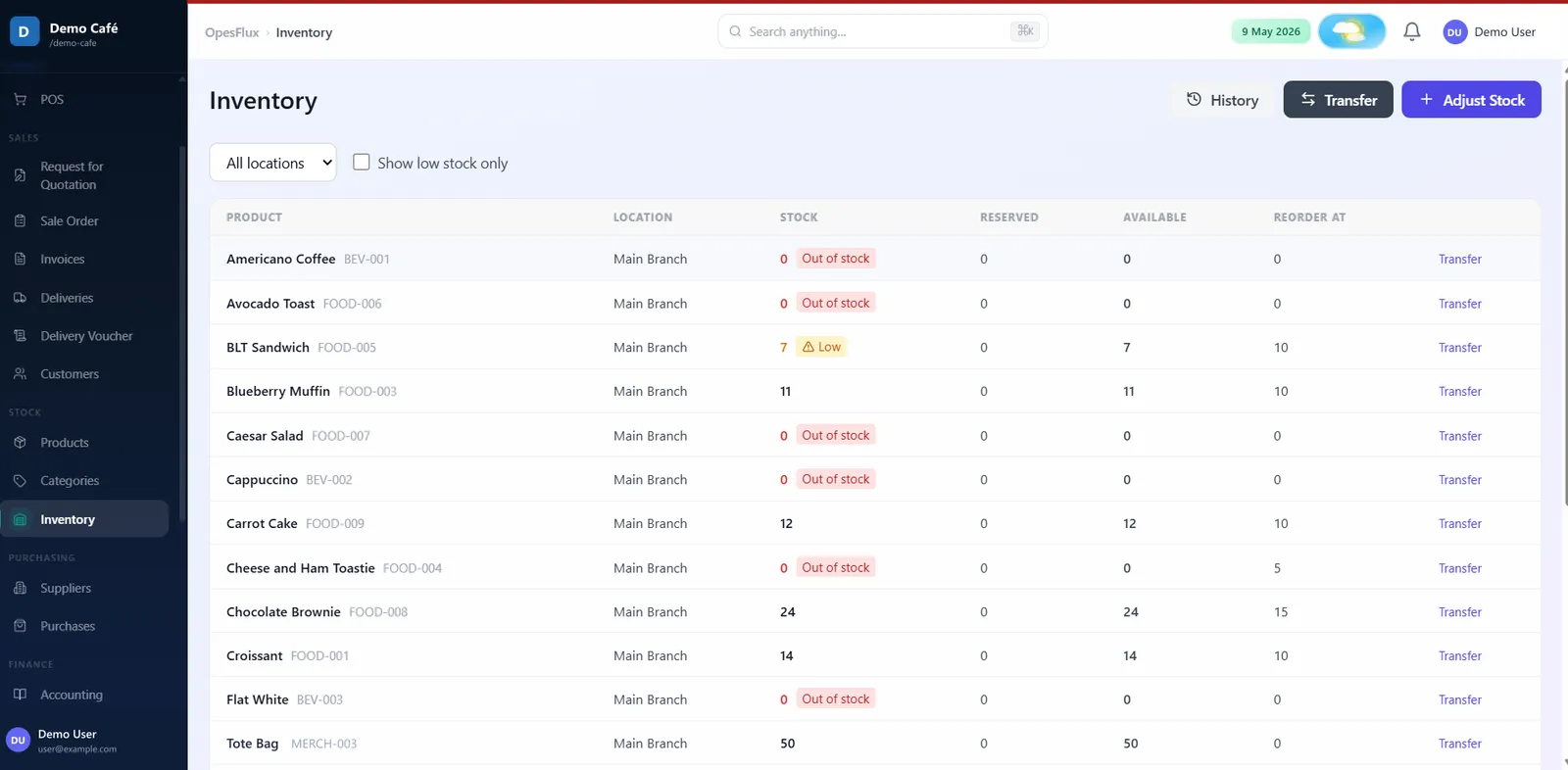
OpesFlux began as a UK system. Then companies in Pakistan and Japan needed it, each with its own currency, tax, dates and payroll rules. We rebuilt the assumptions instead of forking the product.
01 The problem
Where it started
- 01The first version assumed pounds, VAT, UK dates and the server’s clock. Each assumption was scattered through the code.
- 02A second country by copy-and-change would have meant two products to maintain.
- 03Several companies on one database must never see each other’s records, even when a query is written badly.
02 What we built
How it works
Separation in the database
Every table that belongs to a company is protected by row-level security in PostgreSQL. The database itself refuses to return another company’s rows.
Tax per company
Each company has its own tax rates and its own name for the tax: VAT, sales tax or GST. Invoices, quotes and orders print that name.
Time and dates per company
"Today" and the end of the day come from the company’s time zone, not the server’s. Dates display in the company’s format.
Payroll per country
Payroll rules live in one module per country: the UK, Pakistan, Japan and the United States. Adding a country does not touch the others.
Modules per company
Each company has only the modules it uses switched on, from the point of sale to purchasing to payroll.
A point of sale that works offline
The till keeps selling when the connection drops and syncs when it returns.
03 Decisions
Choices that mattered
The UK is a default, not an assumption
A new company starts with UK settings. Nothing in the code is allowed to hard-code a currency symbol, a tax rate or a date pattern.
Copy the facts onto the document
An invoice stores the price, tax rate, product name and address as they were on the day. Changing a tax rate later never rewrites history.
Money is never a float
Every amount is a fixed-precision decimal in the database, so totals add up to the penny, or the yen.
Built with: React, FastAPI (Python), SQLAlchemy, PostgreSQL with row-level security, IndexedDB for the offline till.
Need something like this?
Tell us how the job is done today. The first call is free, and you get a written scope and a fixed quote.
Book a free discovery call